



Precious Metals: The Gold Chart That Will Knock Your Socks Off

(February 9, 2012 - by Sean Brodrick From Money And Markets)
It’s a chart of gold fabrication demand — including jewelry, coin, dental, electronic and other industrial uses — that I made using data from Morgan Stanley.
In a moment, I’ll tell you why this is so important for you to know. But first, let me say that I’m not disputing its data or projection of gold fabrication demand. There’s something else to this chart. Take a look …
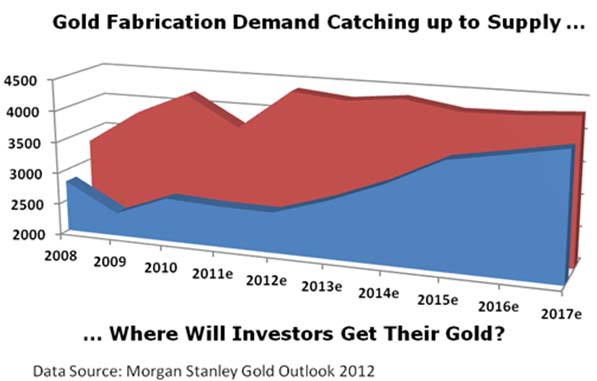
The red line is supply from gold mines, and the blue line is gold fabrication demand. Morgan Stanley’s numbers show that fabrication demand for gold is rising, and estimates indicate that it should soar in the years ahead. The company resolves this by saying that investment demand is going to go down.
With all due respect to Morgan Stanley, I believe it has that part of the equation wrong, and the only way this demand squeeze will be resolved is through much, MUCH higher prices that force fabricators to look for substitutes.
After all, when the price of an investment — whether it’s gold or stocks or anything else — goes higher, do investors want less of it? Heck no! They usually want more — much more!
And this is exactly what I think we’re going to see in gold — a rip-roaring rally that sends gold prices much, much higher.
I have more forces that I’ll be covering in my presentation in Orlando. But even now, there are other bullish factors falling into place for gold, like pieces to a gleaming metal puzzle.
Let me tell you about three important developments that will drive gold prices higher, starting with the fact that …
China’s Gold Imports Are Soaring!
China’s gold imports from Hong Kong more than tripled in 2011 from the year before, hitting a record 428 metric tons.
China does not release official data on gold imports or demand. So the Hong Kong import numbers, published by the Hong Kong Census and Statistics Department, are considered to offer a partial view of overall demand.
According to sources quoted in the Financial Times, one trader at a Chinese bank said China’s total imports last year were at least 30% higher than the Hong Kong numbers. And for 2012, analysts believe China’s gold imports are going to continue to ramp up.
Bottom line: China is going to overtake India as the world’s largest gold consumer, probably sooner rather than later. And China’s hunger for the yellow metal is going to be a major force driving gold prices going forward.
And not only are prices going up, but so is the cost to produce it. Which begs the question …
Have We Hit Peak Gold?
Steve Letwin, the CEO of IAMGold (NYSE:IAG), thinks so. In an interview with Mineweb, Mr. Letwin said: “I think you hit peak gold three or four years ago. You cannot find the large deposits anymore. Most of it (is) lower-grade and in more-remote locations, so it’s going to be difficult for anybody to produce gold at less than $1,200 per ounce in terms of new discoveries.”
Ore grades are falling — from around an average grade of 12 grams per ton in 1950 to about 3 grams per ton in the U.S., Canada and Australia. Miners are now going after ore they used to drive over to get to the big deposits.
They aren’t chasing low-grade ore because it’s fun. They’re going after low-grade ore because it’s all they can find. Now, there are mines going into production with less than a gram per ton of gold, and they’re quite profitable!
Sure, there probably are some high-grade deposits waiting to be discovered. But those higher-grade deposits will be smaller — that’s why they were overlooked the first time around.
People are Losing Faith in Fiat Currency
Fiat currency is paper money — in other words, it gets its value from government say-so. And with the government creating more and more money all the time — the Federal Reserve’s latest weekly money supply report from last Thursday shows that money supply has surged yet again, by more than 35% on an annualized basis — this shakes people’s faith in the value of paper money.
So more and more people are turning to REAL money — gold and silver.
That’s why U.S. Mint sales of American Eagle silver coins were the second highest EVER in January. Meanwhile, gold-coin sales totaled 127,000 ounces last month, the most since January 2011.
But I’m not just talking about individuals. Some state-level legislators are getting so worried about the U.S. dollar, they want out.
Lawmakers from 13 states — including Minnesota, Tennessee, Iowa, South Carolina and Georgia — are seeking approval from their state governments to either issue their own alternative currency or explore it as an option. Just three years ago, only three states had similar proposals in place.
Of all the state proposals circulating right now, South Carolina, Georgia, Idaho and Indiana have the best chance of passing their proposed bills this year. If those bills become law, it could have a domino effect, cutting away one of the underpinnings of the U.S. dollar’s value (NYSEArca:UUP).
And that would be just the latest problem for the U.S. dollar. The greenback has only held its value so well in the last year because the euro looks so bad that the dollar looks downright good in comparison.
When the rug finally gets pulled out from under the dollar’s wobbly feet, the fall could shake the world as we know it.
Bottom line: Gold is Ramping up for its Next Big Move
The forces of supply and demand are lighting the fuse on gold’s next big move. You’ll want to be onboard this metal rocket when it takes off.
-
 Gold & Silver Buyers Are Back By
September 17 2026
-
 Gold & Silver Start Higher But Drop After ¼% Increase In Interest Rates By
September 17 2026
-
 Gold & Silver Awaits Tomorrow’s Fed Decision By
September 15 2026
-
 GOLD & SILVER SELL-OFF ON HIGHER TREASURY YIELDS By
September 15 2026
-
 Gold Is The 'North Star' In A World Drowning In Debt By
September 15 2026