



Trump Tariffs, Rising Inflation Projections Support Gold Silver ETF Outflows Cease As Lease Rates Climb


(February 10, 2025 - Ernest Hoffman, Kitco News)
Feb 10, 2025
(Kitco News) – Gold prices continue to enjoy tailwinds from Trump’s tariff threats and rising inflation projections but could face waning sovereign demand, while silver ETF outflows have stabilized, but lease rates continue to rise, according to precious metals analysts at Heraeus.
In their latest precious metals update, the analysts noted that while central bank demand for gold remains strong by historical measures, fewer are buying and the bulk of purchases are now coming from only a handful of nations.
“Central bank (CB) demand for gold declined by 1% year-on-year in 2024, falling below 1,050 tonnes,” they wrote. “While this appears to be relatively stable, it masks a notable shift in the number of CBs buying and selling gold. In the first half of 2024, an average of 21 CBs purchased gold each month, whereas in the second half of the year, with data available until November, this number had dropped to 17. Moreover, a small number of CBs accounted for the majority of demand in 2024. Poland was the largest buyer, adding 90 tons, followed by Turkey with 75 tons and India with 70 tons. Together, these three countries were responsible for 68% of reported CB gold demand from January to November 2024, highlighting a concentration risk and an elevated reliance on a select few buyers.”
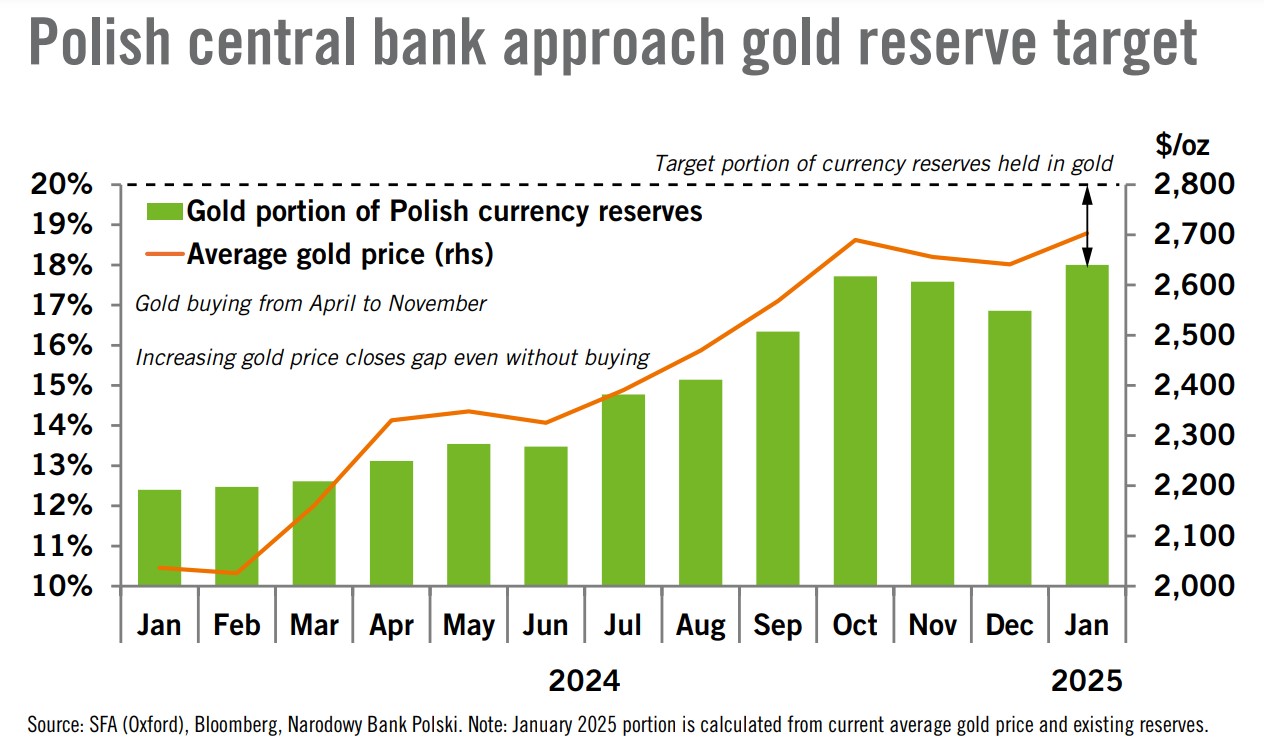
And gold’s recent price appreciation is helping to push the Polish Central Bank closer to its target, making further purchases more conditional.
“Poland’s purchases have been driven by its objective to increase gold’s share of its total currency reserves to 20%,” the analysts said. “Strong buying over the course of 2024 has already raised gold’s proportion of Polish reserves from 12% in January to 17% in November, leaving just a 3% gap to the target (source: Narodowy Bank Polski). The rising spot price of gold over the past month means that the value of the gold reserves will have appreciated to more than $41 billion, bringing the new portion of the portfolio accounted for by gold to 18%. This is notably accompanied by a break in the CB’s monthly buying of gold in December for the first time in eight months. At its current price, $4.6 billion worth of gold (just under 50 tons) would bridge the gap to the currency reserve target, which is just 55% of Poland’s 2024 CB buying demand total.”
Heraeus also addressed the impact of U.S. tariffs on precious metals markets, noting that the one-month delay has done little to rein in inflation fears, which continue to support gold prices.
“The gold price reached five all-time highs within a week, reaching $2,880/oz on Wednesday, despite a temporary easing of tariff concerns after President Trump paused new tariffs on Mexico and Canada in exchange for increased border security,” they wrote. “Meanwhile, breakeven inflation rates for the 2-, 5- and 10-year terms have been trending upwards and remain higher than at the start of the year. Additionally, the University of Michigan’s inflation expectation was up by 20 basis points month-on-month in December. Taken together, this suggests that inflation expectations under the Trump administration have not been quelled, potentially supporting stronger demand for gold as an inflation hedge in the near to medium term.”
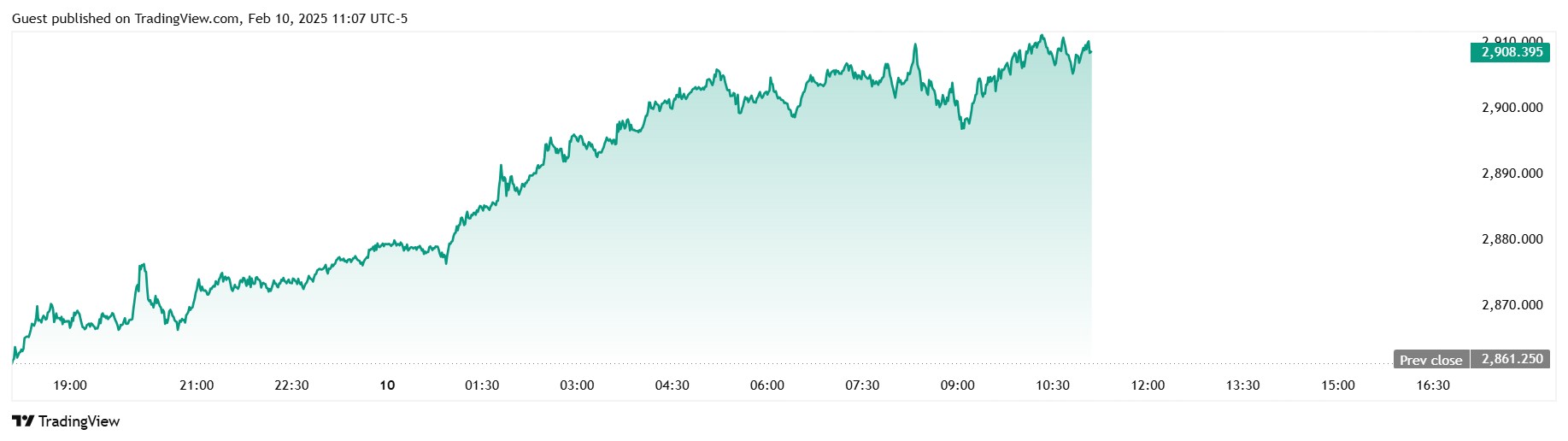
Gold prices rallied above $2,900 per ounce on Monday morning, and they are holding above that level. Spot gold last traded at $2,908.39 per ounce for a gain of 1.65% on the session.
Turning to silver, Heraeus noted that lease rates for silver have shot up.
“Over the past week, one-, three-, six- and twelve-month implied lease rates for silver have all risen, with the one- and three-month rates spiking on Tuesday following news that 25% tariffs on Mexico and Canada were delayed by 30 days but not ruled out, while new 10% blanket tariffs on China remained in place,” they wrote. “In 2020-2023, 44% of US silver imports came from Mexico and 17% from Canada, totalling more than 400 moz over four years. The surge in lease rates likely reflects elevated urgency to receive metal before potential tariff charges apply to its two biggest silver importers. The one-month implied silver lease rate spiked as high as 10% last Wednesday, following moderately elevated levels seen since December.”
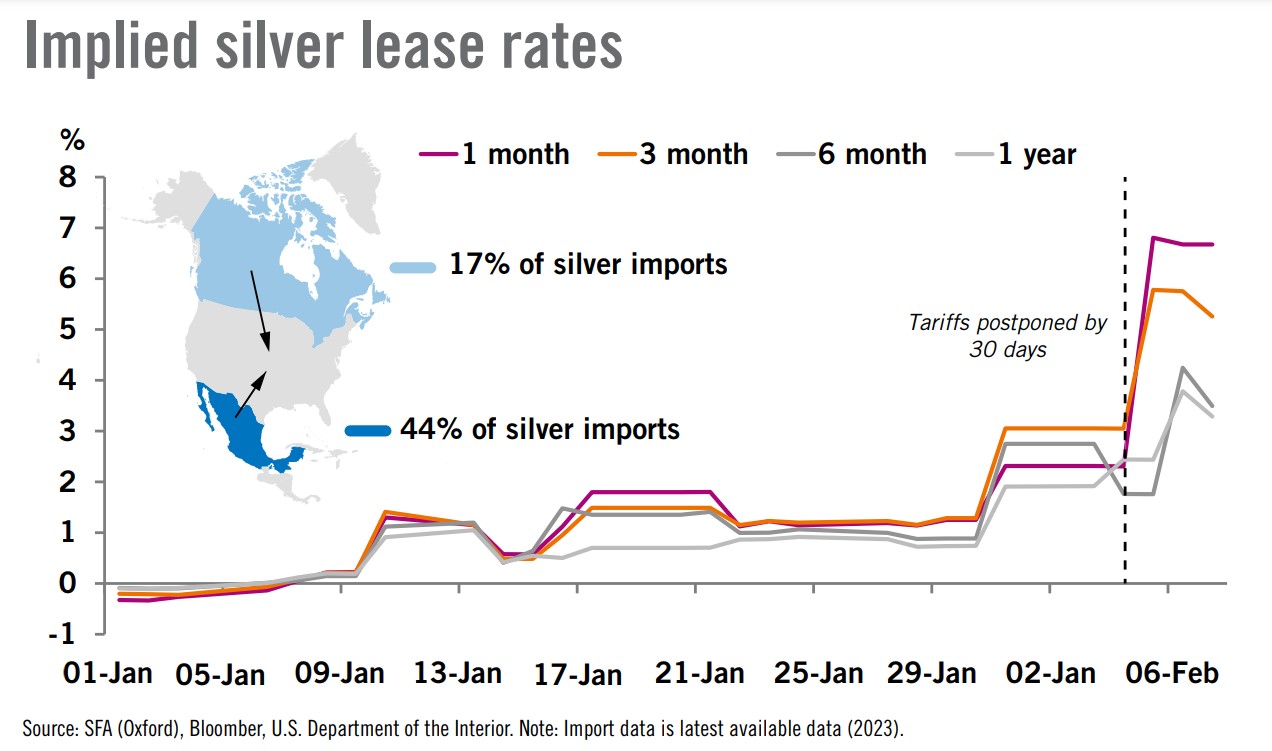
“Silver is far less economical to ship via air transport than gold, resulting in longer lead times by road and sea, and the potential for inbound shipments failing to reach the US border before 4 March,” the analysts said. “This provides incentive for fabricators to receive metal in the US now, squeezing short-term liquidity.”
Heraeus also pointed out that the United States imported 20 million ounces of silver from Hong Kong in 2023, along with $193 million worth of silver jewelry from China.
“Unless goods in transit before 1 February are exempt, silver bullion, paste and other products refined in China or Hong Kong will now face a 10% import tariff,” they said. “Any imports of Chinese silver from 1 February will see a 10% tariff applied. Inflows of physical silver in COMEX inventories slowed last week, yet still growing by 1,700 koz, having increased by more than 40,000 koz since the beginning of the year. However, compared to gold, COMEX silver inventories have seen a much lower level of inflows over the last month.”
Conversely, the recent declines in silver ETF holdings have subsided. “Silver ETFs saw a nine-day losing streak come to an end on Tuesday, marking the longest decline since April last year,” the analysts wrote. “Nearly 8 moz of silver has flowed out of total ETF holdings since the start of the year, which now sit under 706 moz, though the total remains 1% above the level at the beginning of 2024.”
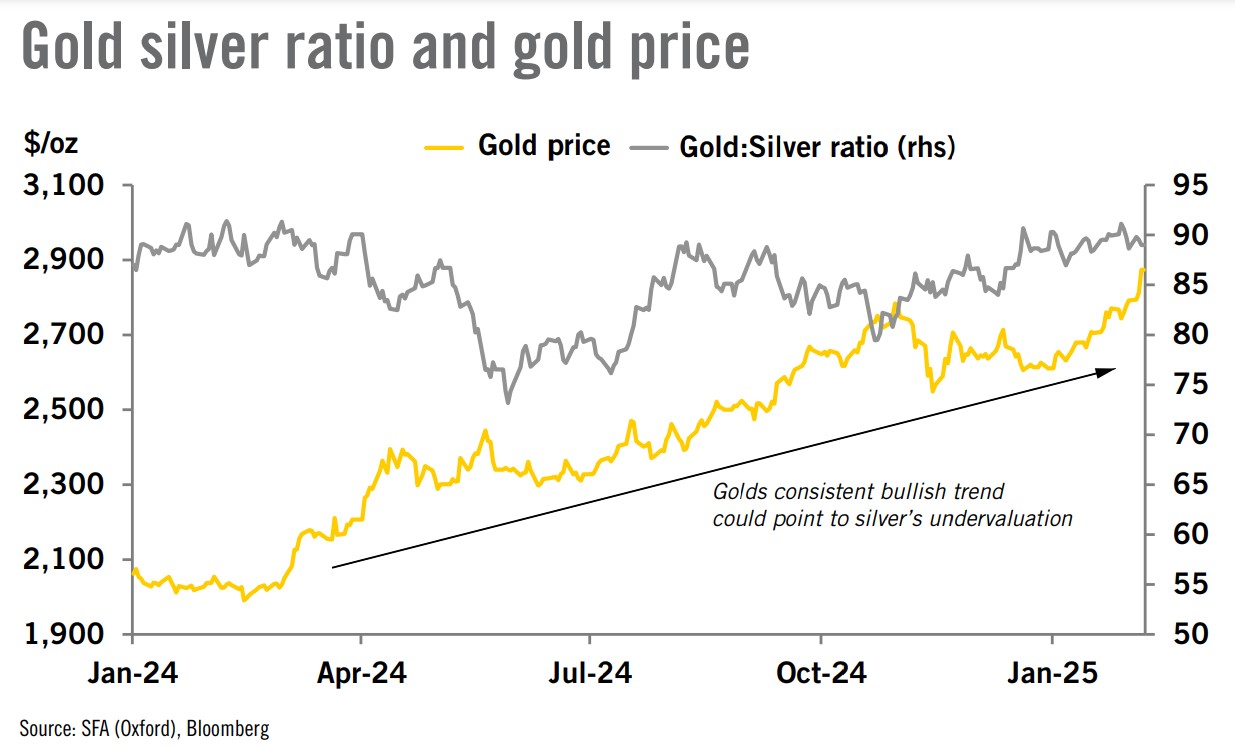
Heraeus believes that silver’s relative underperformance in 2024 compared to gold may have led investors to reallocate funds to the yellow metal despite silver’s significant gains in both ETFs and the spot market.
“The gold:silver ratio remains historically high at 89, indicating silver’s relative undervaluation and the potential for outperformance if conditions shift,” they said. “However, for this to materialise, renewed ETF investment is crucial to drive demand and support higher prices.”
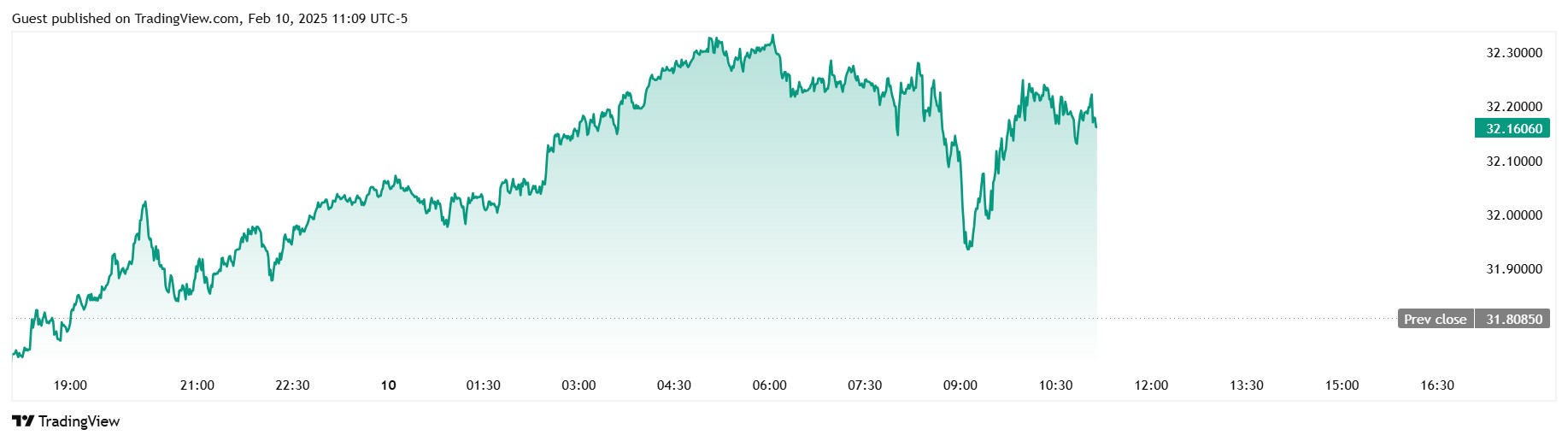
Silver briefly retested the $32 per ounce level shortly after 9 am EST, but support held and the gray metal is trading not far from session highs. At the time of writing, spot silver last traded at $32.162 per ounce and is up 1.11% on the daily chart.
-
 Gold & Silver Stop Dropping And Start Climbing By
September 3 2026
-
 List Of Countries That Have Pulled Gold From U.S. Federal Reserve By
September 3 2026
-

-
 Silver Extends Upswing As Softer Dollar Supports Bulls By
September 3 2026
-
 Gold & Silver Finding Support At Attractive Levels By
September 1 2026