



Why Gold Prices Are Forecast To Rise To New Record Highs

(May 15, 2025 - Goldman Sachs)
Gold is increasingly in focus among traders, investors — and central banks.
The precious metal, which has been used as a financial asset for millennia, is prone to dizzying rallies and deep slumps. But despite the commodity’s volatility, gold has repeatedly set records in recent years.
Since March, investors have been increasing their holdings of gold, driven by concerns about the health of the economy and market volatility. Longer term, Goldman Sachs Research expects prices to be propelled by multi-year demand from central banks. Our analysts’ gold price prediction is for these two factors to push the metal to new record highs.
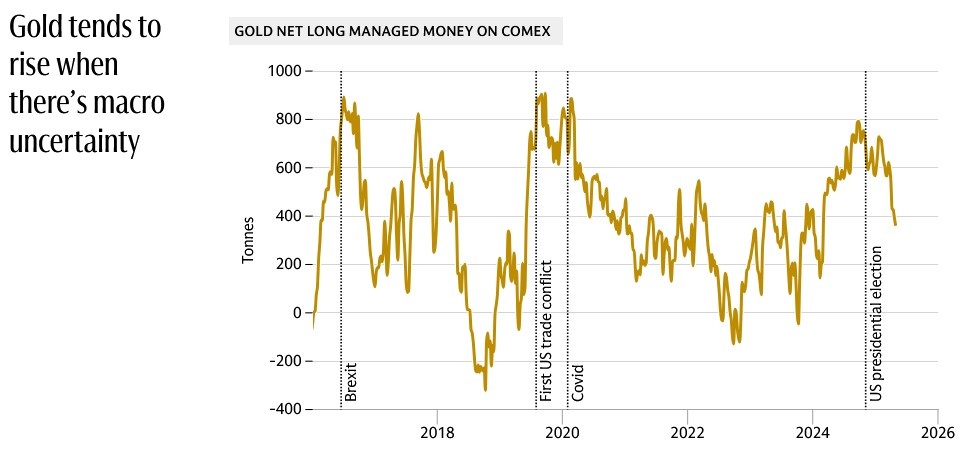 Source: CFTC, Goldman Sachs Research
A snapshot of how hedge funds and other traders are positioned shows that gold trading spikes during periods of geopolitical turmoil. Gold has risen in 2025 amid uncertainty over the Trump administration’s tariffs on major trading partners.
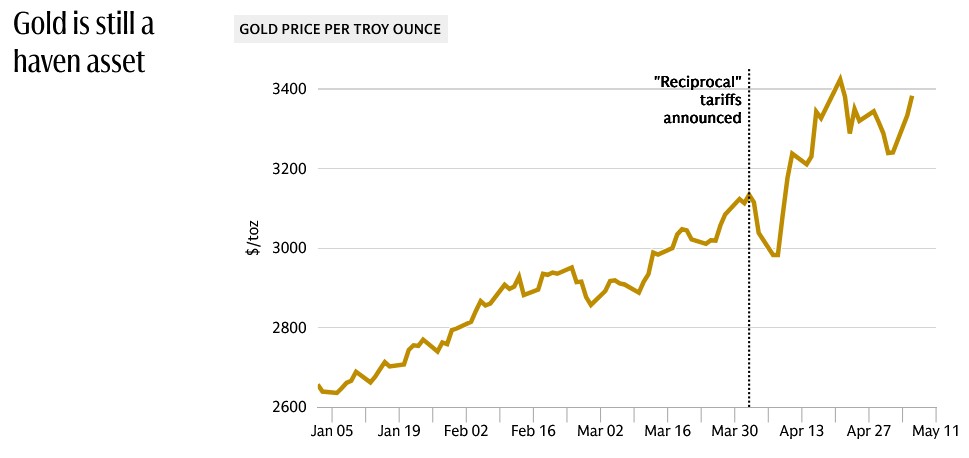 Source: Bloomberg
Some investors were puzzled by the 5% drop in gold prices, a decline in tandem with stocks, after the US announced its country-level “reciprocal” tariffs. Ordinarily, gold is seen as a haven, strengthening at times of volatility and when equities sink.
Thomas explains that gold’s status as a haven asset hadn’t disappeared. Instead, the steep decline in stocks led investors to sell liquid assets like gold to raise cash for collateral against their equity market positions.
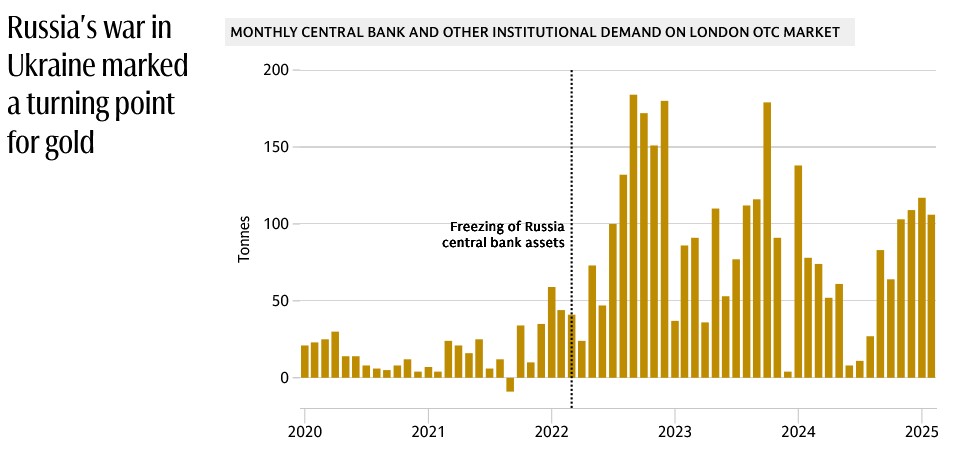 Source: Goldman Sachs Research
G7 countries responded to the invasion of Ukraine by freezing more than $280 billion of Russian assets. Those holdings were primarily euro securities, but also US dollar and other denominations. Most of those foreign assets were held in Brussels.
The freezing of Russian assets in Brussels showed that foreign reserves could potentially be confiscated. As a result, governments have been buying much more gold.
Central banks hold more than $12 trillion in foreign exchange reserves. They keep these assets for a number of reasons, such as diversification, to protect against inflation, and to defend their own currency if it comes under stress (by selling foreign reserves to buy the domestic currency). Foreign reserves are often denominated in the US dollar but also other currencies like the euro.
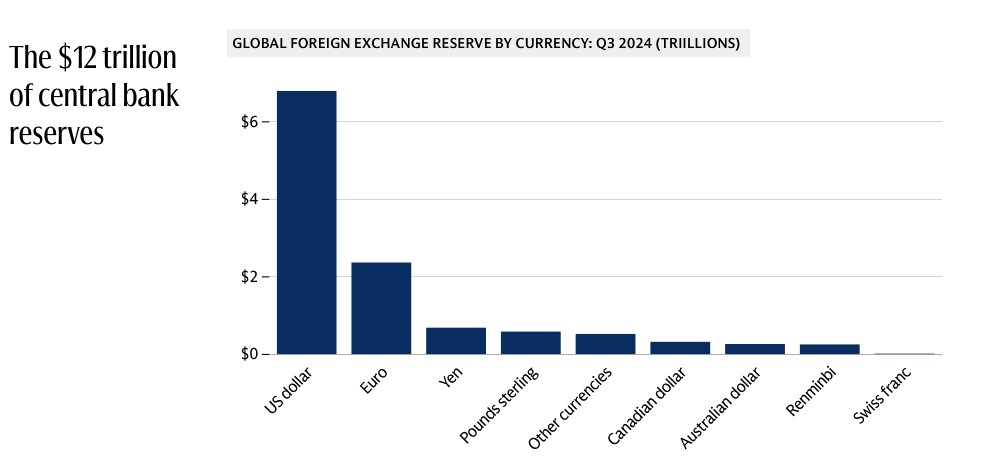 Source: IMF
Since the freezing of Russian assets in Europe, central banks have been buying much more gold. They can keep the metal in their own vaults on their own territory, out of reach of other institutions and governments around the world.
Since 2022, central bank purchases of gold on the London over-the-counter market have increased fivefold, according to Goldman Sachs Research.
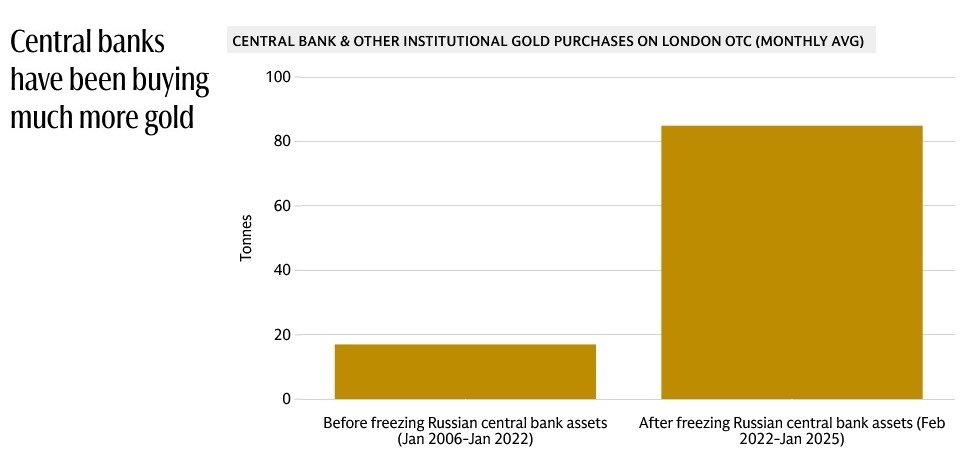 Source: Goldman Sachs Research
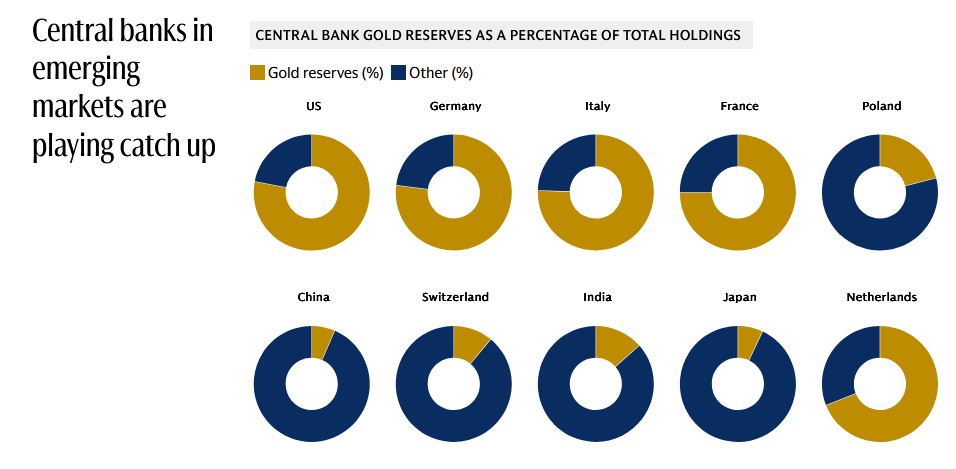 Source: World Gold Council, IFS. As of first quarter 2025.
Emerging market central banks, which have a smaller percentage of their reserves in gold, are also playing catch up with their peers in developed markets, according to Goldman Sachs Research. China holds less than 10% of its reserves in gold, compared to about 70% or more for the US, Germany, France, and Italy.
Developed economies’ large gold holdings are partly a legacy of the gold standard era, when sovereign money supplies were linked to gold.
Interest rates have typically been one of the most important dynamics in gold prices. Because the metal doesn’t offer a yield like bonds, it’s more attractive to investors when interest rates are lower (and vice versa when bond yields are higher).
 Source: Bloomberg, Goldman Sachs Research
While central bank purchases have been the primary factor driving up gold prices in recent years, growing exchange-traded fund (ETF) holdings of gold are also beginning to feed into the mix.
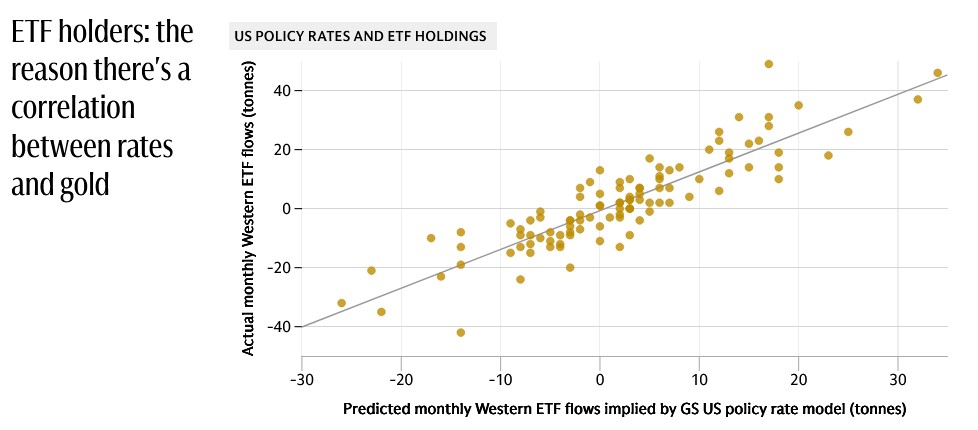 Source: Goldman Sachs Research, Federal Reserve Board. As of March 25, 2025.
ETFs linked to gold have about $294 billion of assets under management, representing about 3,000 tonnes of the material. The likes of pensions and individual retail investors tend to hold the bulk of investments in gold ETFs. ETF holdings typically track interest rates closely.
For this reason, gold prices have historically been correlated with interest rates. More recently, central bank buying has caused the two to diverge, but Thomas says the influence of interest rates hasn’t disappeared entirely. While ETF holdings tend to track interest rates closely, they often overshoot significantly when recession fears grow.
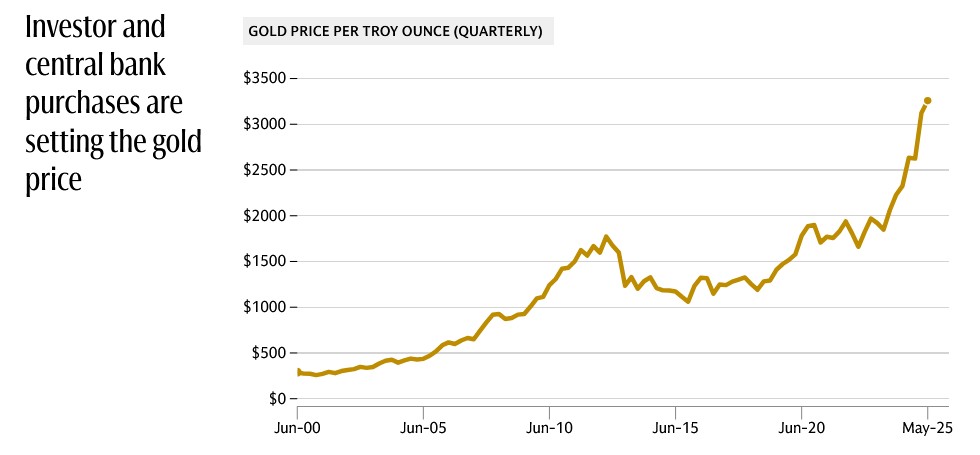 Source: Bloomberg. As of May 2, 2025.
Gold remains a volatile commodity. A range of catalysts, from changes in US Federal Reserve policy to tariff expectations, could cause the metal’s price to gyrate in the coming months.
Goldman Sachs Research’s gold price prediction 2025
Even so, Thomas says gold is likely to break more records this year. Goldman Sachs Research predicts gold will rise to $3,700 a troy ounce by the end of 2025 (from $3,220 on May 15) as central banks buy many tonnes of the precious metal every month.
The commodity is also likely to climb as ETF investors increase their holdings in anticipation of interest rate cuts and amid growing recession concerns. In the event of a recession, Goldman Sachs Research forecasts that gold could rise to as much as $3,880 a troy ounce.
Private investors might also turn to gold to diversify away from US assets, particularly if traditional equity portfolio hedges such as US Treasuries continue to underperform during equity drawdowns. While not the team’s base case forecast, Thomas says even a small rotation out of US assets into gold would have a big, positive impact on the gold price given the relative sizes of the markets. For example, global gold ETF holdings are worth only about 1% of outstanding US Treasuries and 0.5% of the S&P500 market cap.
“While the key factor since 2022 used to be central bank buying alone, ETF investors are now joining the gold rally,” Thomas says. “As both compete for the same bullion, we are expecting gold prices to rise even further.”
-
 Gold & Silver Stop Dropping And Start Climbing By
September 3 2026
-
 List Of Countries That Have Pulled Gold From U.S. Federal Reserve By
September 3 2026
-

-
 Silver Extends Upswing As Softer Dollar Supports Bulls By
September 3 2026
-
 Gold & Silver Finding Support At Attractive Levels By
September 1 2026