
Mint State Gold
-
The Morgan Dollar
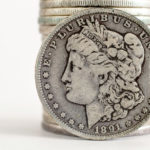
(Read More)The Morgan Dollar, taking its name from George T. Morgan, the British-born seventh Chief Engraver of the U.S. Mint who designed was the coin’s designer. Determined to choose a face for his coin that looked “American” and not like the Greek figures often used at the time, Morgan found what he was looking for in the person of a Philadelphia school teacher, a face Morgan described as the most perfect he had seen in England or America. The model, Anna Willess Williams, took on the role only reluctantly. Later she would claim that it was a decision she’d regret for the rest of her life.
Minted from 1878 to 1904, and then again in 1921, the Morgan Silver Dollar was the first silver coin to be produced after the halt of all silver coinage in 1873 as the country shifted to a Gold Standard. Silver mining interests had lobbied successfully for the unlimited free coinage of silver. At the time, critics and gold advocates feared a such a policy could lead to hyperinflation and economic disaster. A compromise was reached and a return to bimetal minting system came with the Bland-Allison Act of 1878. This required the U.S. Treasury to acquire quantities of silver to be minted into dollars at a rate of $2-$4 million monthly (an equivalent of about $100 million today depending on current silver value).
As a result, Morgan Silver Dollars were minted in the tens to hundreds of thousands, depending on year, to over 44 million in 1921. Availability of some vintage years are impacted by loss through melting – the Pittman Act required the destruction of 270 million (mostly Morgan) silver dollars – a volume of coins, it was claimed, that if stacked on one on top of each other, would form a tower over 400 miles in the sky. As a result, the coin would endure some years of scarcity which in turn influences rarity, condition, and the value of available coins. Also, quality and condition could also be affected by minting provenience. As the Morgan was minted across locations and years to varying affect, the quality, quantity, and value varies widely by year and mint.
Each mint may have its own unique traits and strike characteristics. These differences can make particular coins unusual, rare, and collectible.
Other features of the Morgan Dollar:
- Morgan Dollars were issued from five different mints: Philadelphia, Carson City, San Francisco, New Orleans, and Denver. A short collection involves assembling one Morgan Silver Dollar from each of the five mints
- Die work and striking quality may vary with mint and issue

- Surface appearances such as strike character, relief, and finish may also vary by mint
- Contemporary difficulties in transportation and handling affected condition in certain circumstances – e.g. a lack of access to railways resulted in certain Carson City dollars being heavily bagmarked.
- For the issues of 1878, the reverse side image featured an eagle carrying an olive brand and arrows – versions exist with both eight feathers and seven
- Morgan Dollars offer a variety of investment opportunities including Morgan Silver Dollar Business Strikes, Morgan Silver Dollar Rare Proofs, Morgan Silver Dollar Uncirculated, and others including mintage errors that carry a premium
The Morgan Dollar continues to be one of the most widely circulated forms of silver bullion today, nearly 100 years after the last minting. The Morgan Silver Dollar can offer excellent financial growth opportunities to coin investors looking to add to their coin portfolio.
To learn more about the Morgan Dollar and see how it could fit into your investment portfolio, please contact us and an experienced Mint State Gold representative will be happy to see how we can assist you.
See below for more about Morgan Dollar general specifications:
Morgan Dollar Coin Specifications
Metal(s) Produced Silver Purity 90% Silver and 10% Copper Year(s) Minted 1878-1904, and 1921 Where Minted Carson City/ Philadelphia/ New Orleans/ Denver/ San Francisco Composition 0.7734oz ASW and 0.0866oz Copper Total Weight 0.86 troy oz Denomination $1 Thickness 3.1 mm Diameter 38.1 mm Strike Type(s) Business/ Proof -
The Peace Dollar
(Read More)
Though it may be in the shadow of its older brother coin – the most collected U.S. coin, the Morgan Silver Dollar – the Peace Dollar is well remembered as a symbol of the United States as it rose to be a dominant force in a world newly at peace. It was also the last circulating U.S. silver dollar coin.On the coins’ reverses, both the Morgan and Peace Dollars featured the avatar of the nation’s new position– peace through power: on the Morgan this would be described with the image of an eagle, wings raised, clutching both the olive branch and arrows. Arrows being the symbol of America’s strength and readiness to defend its interests, and the olive branch representing a desire for peace. The Peace Dollar depicts a pensive eagle in profile, holding only the olive branch of peace.
For collectors, the high relief 1921 Peace Silver Dollar as well as the modified, lower relief issues of 1922 to 1935, are popular and prized additions to their collections. Though often overlooked for the Morgan, the Peace Dollar is value-filled series that offers collectors a more accessible challenge than Morgans. The Peace Silver Dollar doesn’t have any tough-to-find rarities in circulated grades, and because of its limited production of only 10 years (no coins were struck between 1929 and 1933), the total number of coins it takes to complete a set is a more reasonable 24.
The Peace Dollar was designed by American sculptor Anthony de Francisci who won the honor of designing the coin in a 1921 competition despite being the youngest and most novice contestant. According to legend, his beautiful wife posed as the model for the Liberty Gold coin obverse. By winning, Francisci would best eight other prominent coin designers, all of whom already had coins of their design in U.S. mintage.
Following the legacy of strong demand for Morgan Dollars, the Peace Dollar would be the second most collected pre-modern silver series in the United States today.
Other notable features of the Peace Dollar:
- Because of its limited production, the Peace Silver Dollar have fewer dates and mints as compared to the Morgan Silver Dollar series; this makes them ideal for collectors and investors looking to build a quality set
- Beginning production in the final year of the Morgan’s mintage, 1921, the Peace Dollar would continue production until 1935
- 187 million Peace Dollars would be struck – a fraction of the Morgan’s half billion total
- The coin was first minted in high relief but due to the difficulties of striking such relief in some cases, the mint decided to lower the relief in order to mint more coins; Morgan Dollars never got a high relief treatment
- These coins are sometimes incorrectly referred to as Morgan Peace Dollars

- To compare the lettering of the Peace Dollars to the Morgan Dollars you’ll note that the Peace Dollar is slightly fuzzy while the Morgan is very sharp and clear; this occurred as a result of the use of a reducing machine, called the Janvier, for Peace Dollars in 1921; coins were struck hastily – over a million completed in the last week of that year
- Extremely rare 1922 Peace Dollars are known to exist: as proof high-reliefs, 6-8 extant, and proof low-reliefs, only 3 extant; a low-mintage 1928-P Peace Dollar commands prices much lower than might befit a mintage of over 360,000 – as an announcement was made that production quantities would be limited, many would be saved by collectors; conversely, the 1934-S dollar was not saved in great numbers and its prices for circulated specimens are generally low but mid-grade uncirculated specimens can cost into the thousands of dollars
- The Wartime Act of 1942 forced the melting of Peace Dollars and later untold millions more were melted as the price of silver shot up to over $50 an ounce in the 1980’s; the numbers of Peace Dollars in existence today is uncertain
High demand and a more competitive price point on many key dates in the Peace Dollars series make this an ideal coin for anyone looking to collect silver coins.
To learn more about the Peace Dollar and see how it could fit into your investment portfolio, contact us and an experienced Mint State Gold representative will be happy to assist you anyway we can.
Peace Dollar Coin Specifications
Metal(s) Produced Silver Purity 90% Silver and 10% Copper Year(s) Minted 1921 to 1928 and 1934 to 1935 Where Minted Philadelphia/ Denver/ San Francisco Composition 0.7734oz ASW and 0.0866oz Copper Total Weight 0.86 troy oz Denomination $1 Thickness 3.1 mm Diameter 38.1 mm Strike Type(s) Business/ Proof -
Canadian Maple Leaf
(Read More)For over 40 years the Canadian Maple Leaf bullion coin has stood as one of the most popular and recognizable bullion coins in the world. Introduced in 1979 as sanctions against South Africa affected supplies of the top selling Krugerrand. The Canadian Maple Leaf was only the second modern bullion coin produced in the world and the first to be of 99.99% pure gold. The coin was an immediate hit and quickly outsold the Krugerrand.
In 1982, with further advances in the refining process, a .9999% pure coin was introduced. Soon after, the Special Edition Gold Maple Leaf Gold coins known as the “Five Nines” offered a purity of .99999%. Thought the Five Nines pure coins are typically more for collecting instead of for investment purposes the Canadian Mint is the world’s only mint to strike coins of this purity.
In addition to their fineness, Canadian Maple Leaf coins are distinguished by their unique and enhanced security measures. Among those features are newer features such as micron-precise tooling which gives the coins an ultra-precise radial line pattern and a very specific light-diffraction that makes these coins unmistakable from any other. Every characteristic of the coin is laser micro-engraved, a feature Maple Leafs share with Canada’s circulating currency coins. These features make the Maple Leaf extremely difficult to counterfeit.
Into the 1980’s and 1990’s, demand for the Canadian Maple Leaf continued to grow. To meet this interest, the variety of coin offerings was expanded to include different weights and sizes in a variety of precious metals. Not all metals continued in production due to various supply limitations. Even so, because Maple Leafs have remained a popular choice as investment bullion coins, they have a strong buy-back value. This is especially evident when compared to the wider range of prices typical for a coin like the Krugerrand.
More about the features of the Canadian Maple Leaf:
- Over the course of the Maple Leaf’s history, the obverse portrait of Elizabeth II has seen three iterations: 1979-1989, Arnold Machin's “39-year-old portrait,” 1990-2004, Dora de Pédery-Hunt's “64-year-old portrait,” and 2005-present: Susanna Blunt's “79-year-old portrait”; the exquisitely detailed image of the maple leaf on the reverse has remained unchanged
- The coins have been issued in Gold, Silver, Platinum, and Palladium

- All gold coins are weighed three times to ensure they contain no less than the guaranteed weight – the coin is weighed as a blank, after it’s stuck, and then again when packaged; silver coins are weighed twice
- A Silver Maple Leaf coin was introduced in 1988 and is .9999% (“four nines”) pure; the standard in silver bullion is .999%
Since its introduction, sales of Silver Maple Leaf coins have grown consistently from 1.15 million coins in 1988 to 34.3 million in 2015; today it is second only in popularity to the American Silver Eagle bullion coin- A Platinum Maple Leaf was also introduced in 1988 and was .9995% pure platinum; it was issued annually in several denominations until discontinued in 2002; a 1 ounce version of the platinum bullion coin was reintroduced in 2009 with a purity of 999.5%
- The Palladium Maple Leaf was introduced in 2005 and produced until 2007; it was issued again only for 2009 and then reintroduced again in 2015; the palladium coins have a purity of .9995%
- A coin with a $1 million face value was introduced and would be the world’s largest gold coin at a weight of 100 kg
It’s important to note that depending on the year of production it’s possible to find a Gold Maple Leaf in different purities ranging from .999 fine, .9999 fine, to .99999 fine. Please be aware that although .9999 fine is the industry standard now, most buyers who purchase older .999 fine Maple Leafs may see wider differences in value when reselling. It’s for this reason that we at Mint State Gold recommend only the purchase of Maple Leafs at a purity of .9999% or finer to all of our gold bullion buyers.
To learn more about the Canadian Maple Leaf and see how it could be an excellent fit into your investment portfolio, please contact us and an experienced Mint State Gold representative will be happy to see how we can assist you.
Canadian Maple Leaf Coin Specifications
Gold Specifications:
Metal(s) Produced Gold Gold Gold Gold Gold Purity 24 Karat 24 Karat 24 Karat 24 Karat 24 Karat Year(s) Minted 1979 to Present 1986 to Present 1982 to Present 1982 to Present 1993 to Present Where Minted Royal Canadian Mint Royal Canadian Mint Royal Canadian Mint Royal Canadian Mint Royal Canadian Mint Composition 1oz Gold 0.5oz Gold 0.25oz Gold 0.01oz Gold 0.005oz Gold Total Weight 1 troy oz 0.5 troy oz 0.25 troy oz 0.01 troy oz 0.005 troy oz Denomination $50 $20 $10.00 $5 $1 Thickness 2.8 mm 2.23 mm 1.7 mm 1.22 mm 0.92 mm Diameter 30 mm 25 mm 20 mm 16 mm 13.9 mm Strike Type(s) Business/ Proof Business/ Proof Business/ Proof Business/ Proof Business/ Proof Silver, Platinum, and Palladium Coin Specifications:
Metal(s) Produced Silver Platinum Palladium Purity 99.99% Silver 99.95% 99.95% Year(s) Minted 1988 to Present 1988 to Present 2005-2010, and2015 Where Minted Royal Canadian Mint Royal Canadian Mint Royal Canadian Mint Composition 1oz Silver 1oz Platinum 1oz Palladium Total Weight 1 troy oz 1 troy oz 1 troy oz Denomination $5 $50 $50 Thickness 3.29 mm 2.62 mm 2.87 mm Diameter 37.97 mm 30 mm 33 mm Strike Type(s) Business/ Proof Business Business -
South African Krugerrand
(Read More)The first South African Krugerrand one ounce coins were struck in 1967 and it was an instant hit. The first run of 40,000 coins were quickly supplemented with an additional 10,000 special edition proofs targeted to collectors. Since then, over 54 million units of this of Bullion Coins have been produced at the South African mint. Although it's demand has dropped substantially over the decades compared to the now more in demand coins such as the American Gold Eagle, Gold Maple Leaf, and Gold Buffalo Coin, it's still known to be the oldest modern bullion coin produced.
Even today only the now far less popular Krugerrand can still make these claims:- The world’s most produced modern bullion coin
- The world’s most recognized gold bullion brand (I.E. Movies and Marketing released in the 1970's to 1990's)
- The world’s first legal tender gold bullion coin to gain worldwide use
More than any other gold investment, the South African Krugerrand was the coin that inspired global interest in private ownership of gold bullion. Until the Gold Maple Leaf was issued in 1979, the Krugerrand was the only bullion investment coin available in the world market. In 1980, while South Africa’s gold mines accounted for 75% of the Western world’s total gold output, the Krugerrand accounted for 90% of the private gold market. 1980 was also the year when the Krugerrand introduced other sizes to its offerings: the 1/2 ounce, 1/4 ounce, and 1/10 ounce gold coins.
Not until the introduction of the U.S. American Eagle in 1986, and with sanctions imposed on apartheid South Africa, did the Krugerrand fall from its rank as world’s top selling Gold Bullion Coin.
The Silver, Platinum, and 50-ounce Gold Flagship South African Krugerrands: In 2017, in celebration of the 50th anniversary of the Krugerrand, the South African Mint introduced the Silver Krugerrand and Platinum Krugerrand:
- The mintage for the silver Krugerrand was one million units plus a limited quantity of proof strikes for collectors
- The Platinum mintage of 1 ounce coins at .9999% purity had only 2,017 pieces produced
- A flagship offering is a limited edition 50-ounce gold coin‚ 50 times larger than the standard Krugerrand; only 55 coins were issued for purchase
The dies for the Silver Krugerrand were digitally enhanced with innovative laser-etching technology not available when the coin was originally minted in 1967. The technology allows for razor-sharp detail, highlights, and shading not seen on any Krugerrand coin previously.
Although the mint had previously released a higher-premium “K-Rand” in silver for 2017 targeted for collectors, the 2018 issue is the first coin available at a low bullion premium. This is the first year the coin has been offered as a Brilliant Uncirculated Silver coin. Created from the original gold Krugerrand design, the coin was struck in one full ounce of .999 fine silver. The South African Mint created the 1 ounce silver bullion coin as an opportunity for investors to enjoy an affordable investment vehicle also tied to the great Krugerrand legacy.
More features of South African Krugerrand Coins:
- The 22 karat Gold Krugerrand is minted in a copper-gold alloy that is more durable than pure gold; the mix of 91.67% gold bullion with the copper alloy gives the South African Krugerrand its unique orange-gold color tone
- In 2018 the South African Mint released the business strike version of the coin in higher mintages
- Since its introduction in 1967, Krugerrands have been struck every year with occasional slight variations in diameter and thickness
- In the minting process for the Silver Krugerrand, each coin is hand positioned and pressed several times at a lower weight, allowing for an immaculate transfer of detail and ensuring a spectacular gloss for every coin struck
- For its 2017 mintage, for the first and only time a Krugerrand was issued in silver proof and bore a special 50th anniversary mint-mark
- The total value of Krugerrands produced to date is well over $70 billion at today’s values
To learn more about the South African Krugerrand and to see how it could fit into your investment portfolio, please contact us and an experienced Mint State Gold representative will be happy to see how we can assist you. Our mission at Mint State Gold is to provide our clients with the best possible information and to strive to offer the best opportunities for adding to your precious metal holdings.
South African Krugerrand Coin Specifications
Metal(s) Produced Gold Gold Gold Gold Silver Purity 22 Karat 22 Karat 22 Karat 22 Karat 99.9% Year(s) Minted 1967 to Present 1980 to Present 1980 to Present 1980 to Present 2017 to Present Where Minted South African Mint South African Mint South African Mint South African Mint South African Mint Composition 1oz Gold and 0.09oz Copper 0.5oz Gold and 0.045oz Copper 0.25oz Gold and 0.02oz Copper 0.01oz Gold and 0.009oz Copper 1oz Silver Total Weight 1.09 troy oz 0.55 troy oz 0.27 troy oz 0.109 troy oz 1 troy oz Denomination N/A N/A N/A N/A N/A Thickness 2.84 mm 2.2 mm 1.9 mm 1.35 mm 2.84 mm Diameter 32.8 mm 27 mm 22 mm 16.6 mm 38.7 mm Strike Type(s) Business/ Proof Business/ Proof Business/ Proof Business/ Proof Business/ Proof -
American Indian Head
(Read More)As the last Liberty Head coin was produced in 1908, the American Indian Head coin was to be its replacement. Though, the coin that it would eventually come to be was something other than was originally intended: commissioned by Theodore Roosevelt to be more in a style reminiscent of ancient coins struck by the Greeks and Romans, the image of an Indian was used – an ironic choice given the President’s famous animosity toward the country’s indigenous people.
Though images of Indians had been used on coins before, the Indian Head Gold coin is said to be the first image fashioned after actual Native Americans. Earlier representations had not reflected the ethnology of their subjects at all. Such is the legend of the Indian Cent which was said to have been modeled on images of Caucasian women in a war bonnet.
As with the Liberty Gold coin before it, the American Indian Head coin was also designed by Augustus Saint-Gaudens. The new coins would be issued in smaller sizes including four gold pieces and a cent. Only two were issued, the $2.5 and $5 sizes. When Saint-Gaudens died of cancer in 1907 before completing all of the coins, sculptor and former student of his, Bela Lyon Pratt, was engaged to finish the coins in a rush. In an unusual circumstance, changes would be made without congressional authorization. Mint officials assumed that, like all previous coins minted, that whatever design was selected for the Double Eagle, it’d be fitted into a scaled-down for the three lower denominations – such would not be the case. President Roosevelt’s desire was that the Eagle and Double Eagle would bear different designs, something never done before.
At Mint State Gold by Stuppler we will often recommend the $2.50 Indian Head Gold coin AKA Quarter Eagle Gold coin to new clients as an accessible entry point into collecting gold coins. Depending on year and grade, coins may be priced as low as $300.
More about the features of the American Indian Head:
- The $2.50 Indian Head Gold coin were produced intermittently from 1908 through 1929; some 15 different varieties were coined
The $10 Indian Head Gold coin was struck by the U.S. Mint continuously from 1907 until 1916, then irregularly until 1933- The scarcest of the coins produced was the 1911-D, of which just 55,680 were minted, the only issue to be produced in a quantity of fewer than several hundred thousand pieces; choice Uncirculated Indian Quarter Eagles Gold coins are hard to find, particularly among the earlier dates; due to the nature of its design, even a small amount of handling tended to cause nicks and marks on the surface
- The Indian Quarter Eagle Gold and Half Eagle Gold represented an innovation in American coinage; the designs were incuse or inset in the surface – the field of the coin, the part of the face that’s normally lowest, became the highest; incusing was a method used in ancient times and had never before been utilized in circulating U.S. issues
- Extremely valuable versions of the coins include the 1909 Indian, highly prized and sought out regardless of the condition – because of its rarity even some of the worst preserved pieces sell for more than $3,000; also, the 1929 Indian is also very rare and tends to sell high regardless of condition
You may find a variety of mintage years and locations currently available on the Mint State Gold by Stuppler website.
Because so few of these coins were minted, they tend to be highly sought after. Even for coins in poor condition, they’re still quite popular among collectors and investors alike. Because of this scarcity, even coins in poor condition – common among circulated coins – are still highly prized and in demand among collectors. Mint State Gold is always looking for these sought-after pieces given that we are one of the worlds largest market makers not only in this series, but several other of the largest series traded today as well.
To learn more about the American Indian Head and see how it could be an excellent fit into your investment portfolio, please contact us here and an experienced Mint State Gold representative will be happy to see how we can assist you.
American Indian Head Coin Specifications:
Metal(s) Produced Gold Gold Gold Purity 90% Gold and 10% Copper 90% Gold and 10% Copper 90% Gold and 10% Copper Year(s) Minted 1907-1933 1908-1929 1908-1929 Where Minted Philadelphia/ Denver/ San Francisco Philadelphia/ New Orleans/ Denver/ San Francisco Philadelphia & Denver Composition 0.48375 AGW and 0.053 Copper 0.2419 AGW and 0.027 Copper 0.1209 AGW and 0.013 Copper Total Weight 0.537 troy oz 0.269 troy oz 0.134 troy oz Denomination $10.00 $5 $2.5 Thickness 2.03 mm 1.59 mm 1.27 mm Diameter 27 mm 21.6 mm 18 mm Strike Type(s) Business / Proof Business / Proof Business / Proof -
French Gold Rooster
(Read More)The French Gold Rooster, like the country it represents, has a rich and complicated history. As an investment and bullion coin, our Mint State Gold clients have found that the French Gold Rooster performs well in the international market place and has historically yielded tight spreads between buying and selling prices. For this reason, we believe the 20-franc French Gold coin is an excellent investment choice.
About that complicated history: The French Gold Rooster was produced for a limited mintage of 16 years. For the last seven years of the issue, coins dated 1907-1914 have been officially declared restrikes. The French Gold coin was restruck by the Paris Mint in a few later years. Later still, the French Mint of Monnaie de Paris minted golden francs for circulation on and off until the time France adopted the Euro in 2002.
The restrike was called la refrappe Pinay (the Pinay restrike). The difference between the original coins (1899-1906) and the restrikes is the edge: The original inscription read Dieu Protege la France (God Save France); for the restrike it read Liberte Egalite Fraternite (Liberty Equality Fraternity). Otherwise, there’s no difference between the coins. A feature of most of these restrike coins is that they can sometimes come in Brilliant Uncirculated condition (a hard find with 100+ year old coins).
The use of the Gallic Rooster as a symbol came to France from the Romans. In 58-52 BCE, the Romans conquered the region and named it Gallia (Gaul). This sounded similar to another Roman word, galus, meaning rooster. Because of the similarity between the two, Gaul would be confused with galus and so the association stuck.
In the 6th century CE, the Germanic Franks would conquer the Roman province. In the 14th century, coins were inscribed with Francorum Rex, (King of the Franks) in deference to the reign of Jean le Bon (1350-64). By 1795, Franc became the official name of the currency.
Mint State Gold by Stuppler has many of these beautiful coins in stock, dates will vary – all will be dated pre-1933.
More on the features of French Gold Rooster:
- The Rooster was minted from 1898 to 1914; production was halted with the start of World War 1
- French Gold coins are available in a variety of sizes ranging from 5-franc to 100-franc
On the coin’s obverse is an image of the Marianne, a personification of liberty and reason and the national symbol of the French Republic; on the reverse is the rooster, the unofficial symbol of French pride and culture- The French Gold coin is often seen as a great value in fractional gold bullion – premiums over their gold melt value are often available less per ounce than what you’d expect to pay for modern ¼ ounce American Gold Eagle or Canadian Gold Maple Leaf
- The Most Popular and in demand size is the 20 franc. The coin contains about 1/5 of an ounce of gold at typically lower premiums than modern gold fractional bullion. A great value.
- Reliefs on both sides of the Rooster were created by legendary French sculptor, medalist, and presidential portraitist of France, Jules-Clement Chaplain; the rooster is known to the French as le coq gaulois; his medals for Nicholas and Alexandria of Russia were said to be the finest ever struck
Because the French Gold Rooster symbolizes the French Revolution, it holds additional value for its historical significance. Among our collection of gold coins offered for sale from Mint State Gold by Stuppler, are coins from the many various regional French mints. Each French Gold coin will have special identifying marks, giving them additional investment and numismatic value. Since 1878, the Monnaie de Paris has been the sole French mint producing coins.
To learn more about the French Gold Rooster and see how it could fit into your investment portfolio, please contact us here and a highly experienced Mint State Gold representative will be happy to assist you with all your questions.
French Gold Rooster Coin Specifications
French Gold Angel Coin Specifications
Metal(s) Produced Gold Purity 90% Gold Year(s) Minted 1907 to 1914 Where Minted Paris Mint (Add'l Mints Vary) Composition 0.1867 Gold Total Weight 0.207 troy oz Denomination 20 Francs Thickness 1.4 mm Diameter 21 mm Strike Type(s) Business -
French Gold Angel
(Read More)
The 20-franc French Gold Angel coin, also known as The Lucky Angel / Genius, has a proven record of performance crossing decades. It continues to be in high demand as an investment and Bullion Plus coin. With its general strong market demand and competitive buy and sell spreads, the French Gold Angel makes an excellent investment choice. Compared to similar-sized fractional gold bullion coins, the 20-franc Gold Angel has shown a strong liquidity and market demand, especially in Europe. Many gold investors have chosen French Gold coins over modern Gold Eagles and Gold Maple Leafs as the investment of choice.- French Gold Angels are five to ten times rarer and can be more coveted in Almost Uncirculated to Uncirculated Condition than its younger sibling the French Gold Rooster gold coins
- Angels were minted from 1871 to 1898; because of their age, Angels are generally delivered in extra fine to almost or lightly circulated condition
- French Gold Angels come in a variety of sizes from the 5 to 100-franc; we’ve found that there’s a far greater demand and better buyback values for 20-franc coins – especially for purchases where the coin size is about 1/5 ounce of gold each – and for this reason 20-franc coins are the ones we most recommend

- Angels were Europe’s first currency coin, became the basis for Europe’s first monetary union, and facilitated world trade
- Also called the Genius coin for its depiction of the Angel of that name signing the French constitution on the obverse; on the reverse, a wreath surrounds the coin’s denomination
- The coin was designed by French sculptor Augustine Dupré; prior to designing the Angel, he was known for his work engraving sword hilts and sculpting medals; while working as the medalist to the King Louis XVI, Thomas Jefferson – at that time, the United States' minister to Paris – selected Dupré to design a gold medal to honor naval officer John Paul Jones – he would later also design a medal for Benjamin Franklin
The Legend of Lucky

Of the three legends surrounding the French Gold Angel coin and its designer, the most popular had to do with Augustine Dupré facing execution by guillotine during the French Revolution’s Reign of Terror. As he knelt before the blade, he pulled a Gold Angel from his pocket, rubbed it for luck and whispered a prayer. A bolt of lightning struck nearby and in the ensuing panic, his execution was halted. Six months later he was freed and till the end of his days claimed that his Lucky French Angel had saved him.
Napoleon was so moved by the story he also carried the coin for luck. It is said he lost his coin the day before he met defeat at Waterloo. Its power as an amulet of luck continued through both World Wars and was often carried by Aircraft/Boat Captains to insure a safe return home after a mission.
Though Dupré designed the coin in 1793, the French Gold Angel coin wasn’t minted until almost 80 years later in 1871. Dupré wouldn’t have lived to see its minting. If he did unpocket a coin before the guillotine, it was more likely a Gold 1 Louis d'Or. Nonetheless, the legend of the Lucky Gold Angel was born.
To learn more about the Gold Angel and see how the French Gold coin could fit well into your investment portfolio, please contact us here and an experienced Mint State Gold representative will be happy to see how we can assist you.
French Gold Angel Coin Specifications
Metal(s) Produced Gold Purity 90% Gold Year(s) Minted 1878 to 1898 Where Minted Paris Mint (Add'l Mints Vary) Composition 0.1867 Gold Total Weight 0.207 troy oz Denomination 20 Francs Thickness 1.4 mm Diameter 21 mm Strike Type(s) Business -
British Gold Sovereign
(Read More)The British Gold Sovereign may have the coolest backstory of any coin on the market. The coin was first issued in 1489 in tribute to King Henry VII’s victory of the throne. He would be the first monarch of the long reign of the House of Tudor, a line that continues to today, and the last King to seize the throne through war. His taking of the throne was a climax to nearly century of skullduggery and intrigue that included brother against brother plots, assassinations, skirmishes, and strife – a real life Game of Thrones. It’s no coincidence that the popular television series loosely based its plot on the chaos of the period.
The British Gold Sovereign holds the distinction of being the world’s most recognized and respected medium of exchange for over 500 years. At Mint State Gold by Stuppler, the Gold Sovereigns we offer are from a series introduced in 1816. Since that time, the reverse of the Sovereign has depicted an image of Saint George slaying the dragon. With some modifications, the original image has remained on the coin as it’s produced today.Over the years, the coin’s obverse has featured the contemporary monarchs of the time and on occasion may have included several portraits over the course of a single monarch's reign.
At Mint State Gold, depending on present availability, we may have a variety of random year Gold Sovereign coins available, both pre- and post-1933. Although we at Mint State Gold strongly recommend the pre-1933 coinage for many beneficial reasons.
Other notable features of the British Gold Sovereign:- The British Gold Sovereign is just about ¼ ounce in gold and doesn’t display a denomination;
- Monarchs featured on the coin’s obverse include Edward VII, George V, Victoria, and Elizabeth II
- Coins dated prior to 1934 may offer additional benefits for Bullion Plus investors
- The design was created by renowned Italian-born engraver Benedetto Pistrucci who also engraved the dyes himself
Also unique to the Sovereign is the fact that the British Royal Mint has also minted the coins around the globe; mints in Australia, India, Canada, and South Africa have all occasionally produced coins- The Gold Sovereign, along with the early 20-franc French Gold coin and the Swiss Gold coin, have a large following of collectors whom appreciate that high unlikelihood that these coins would be recalled should the U.S. decide to embark on another gold confiscation
Mint State Gold by Stuppler has helped tens of thousands of coin collectors and sellers learn more about their collections. If you’d like to learn more about the British Gold Sovereign or other investment and collectible coins and see how they could fit into your investment portfolio, please contact us here and an experienced Mint State Gold representative will be happy to assist you any way we can.
British Gold Sovereign Coin Specifications
Metal(s) Produced Gold Purity 90% Gold Year(s) Minted 1878 to 1898 Where Minted Paris Mint (Add'l Mints Vary) Composition 0.1867 Gold Total Weight 0.207 troy oz Denomination 20 Francs Thickness 1.4 mm Diameter 21 mm Strike Type(s) Business -
Swiss Gold Helvetia
(Read More)
Coinage of the Swiss Gold Helvetia series was authorized by the law in 1896. A year before artist and medalist Fritz Landry won a design competition to create the final rendering of Helvetia, the Swiss version of Lady Liberty (her name is a tribute to the ancient Gaulic and Celtic peoples who once inhabited the territories of Switzerland, also called Confoederatio Helvetica by the Romans). The jury would demand several rounds of changes to transform her profile from the romantic and “frivolous” to the more mature and serious looking figure we know today.Before Switzerland was known as the world’s premier banker and secret wealth stash, it was a country with a dizzyingly chaotic monetary system. With every canton, city, abbey, principality, and lordship printing their own currency, plus foreign and older currencies in majority use, there were 860 coins in general circulation by the end of the 18th century. By 1820, the number would be 8,000! And worse, all these various forms of legal tender were inconsistent in value and denomination. All this for a country of just over 2 million people at a time when yodeling across hill and dale was still the major form of communication (the telephone was still decades away).
To address this monetary madness, reforms were enacted in 1850 and, for the first time, the financial system would be unified under a single currency unit. Though the Swiss franc had been issued in 1803, it wasn’t until the reforms 47 years later that the Swiss government would be the only entity allowed to mint a nationalized currency.The final authorized figure of “Swiss Miss,” as she’s affectionately known by locals, would feature a garland of Edelweiss around her neck and a backdrop of the Alps crossing the coin’s span. Known as Vreneli in Switzerland, legend says the coin’s name comes from a character in the popular Swiss folk tale William Tell.
Other notable features of the Swiss Gold Helvetia:
- The Swiss Gold Helvetia is one of the world’s most popular pre-1933 European gold coins and traditionally trades at low premiums over the gold price
- The Helvetia Swiss Gold coin was originally released in 1897 and was struck every year after until 1936 – ceased due to the Great Depression – when their legal tender status ended; because of the coin’s popularity, some restrikes were issued.
Though the coin has been produced in various sizes the 20 Franc has been shown to be the most popular historically by far.- The 20-francs Helvetia was part of an extensive European program to develop a uniform gold currency unit under the Latin Monetary Union which also included the French Gold Napoleon coin as well as the Greek drachmae, the Italian Lire, the Belgium franc, and others
- These coins are very finely detailed and should only be purchased in high quality grades of Uncirculated to Brilliant Uncirculated; the coins may exhibit a few minor scratches and little wear
For investors, the Swiss Gold Helvetia provides one of the best options due to its popularity going back to the mid-twentieth century. Demand for the coin continues to be strong even today. For this reason, many dealers find acquiring Pre-1934 Swiss Gold coins in Brilliant Uncirculated condition very difficult. This demand creates additional premiums for the coin in excess to its value in gold content. At Mint State Gold by Stuppler we’ve recommended the purchase of Swiss Gold Helvetias for many of our Bullion Plus investors. The Swiss Gold coin provides an excellent opportunity for diversifying portfolios of both gold and collectibles.
To learn more about the Swiss Gold Helvetia general specifications and to see how it could fit into your investment portfolio, please contact us here and speak with an experienced Mint State Gold representative who’ll be happy to assist you any way they can.
Coin Specifications
Metal(s) Produced Gold Purity 90% Pure Year(s) Minted 1897-1935, 1947 & 1949 Where Minted Bern Mint Composition 0.1867 Gold Total Weight 0.207 troy oz Denomination 20 Francs Thickness 1.4 mm Diameter 21 mm Strike Type(s) Business -
French Gold Napoleon
(Read More)If coins are history in your hands, then the adage has never been truer than with the French Gold Napoleon. First issued in 1803, a year before Napoleon Bonaparte became Emperor, the coins would feature an effigy of Bonaparte in both a bare-headed and laurel wreath-crowned version.
Having the distinction as being the first President and last monarch of France, Napoleon would reign from 1803 to 1814. Other versions of a Napoleon gold coin would continue to be struck until the beginning of World War I.
For the collector and investor, the Napoleon 20-franc size has proven to be in far less demand than other French Gold coins. Also, while larger coin sizes have been sought after by investors, demand for smaller 5 and 10-franc sizes have notably declined over the years. Due to these fluctuations in the market for the other denominations, an opportunity arose for the creation of other French 20-franc coins. The Napoleon 20-franc was followed by the more popular French Gold Rooster and French Gold Angel. The dynamic market for these coins allows for excellent deals for the investor looking for a Bullion Plus coin to add to a diversified gold bullion portfolio.
Other notable features of the French Gold Napoleon:
- Napoleon coins were originally minted in 20-franc and 40-franc denominations; the 20-franc coins were similar in diameter to the U.S. nickel while the 40 was about 5 mm larger (the 40-franc gold piece was never popular in circulation)
- Both the 20-franc and 40-franc coins are 90% pure gold
- Coins were made in various sizes and denominations including 5, 10, 20, 40, 50, and 100-francs; the 20-franc size is the most traded today with the most generally aggressive buyback values
Napoleons were made in wide variety of different designs including coinages depicting the two Napoleons – Napoleon I (Bonaparte) and Napoleon III (Bonaparte’s nephew) – some coins bear the signature or identifying symbol of the master engraver of the dies; some coins were minted for a time in annexed or occupied countries – Italy, Switzerland, and the Netherlands – and a London mintage at the decree of King Louis XVIII in 1815; the Napoleon III coins would be minted in three versions- The reverse of the coin would contain the letters RÉPUBLIQUE FRANÇAISE (French Republic) until 1809, after it was EMPIRE FRANÇAIS (French Empire)
- Napoleons would become “The Euro before there was a Euro” across Europe as France attempted to create a Franc-based gold standard known as the Latin Monetary Union
To learn more about the French Gold Napoleon and see how it and other French Gold coins could fit into your investment portfolio, please contact us here and speak with an experienced Mint State Gold representative who’ll be happy to assist you any way they can.
French Gold Napoleon Coin Specifications
Metal(s) Produced Gold Purity 90% Pure Year(s) Minted 1807-1870 Where Minted Various French Mints Composition 0.1867 Gold Total Weight 0.207 troy oz Denomination 20 Francs Thickness 1.4 mm Diameter 21 mm Strike Type(s) Business